
Columbus Residents Overwhelmingly Demand Data Center Moratorium and Stronger Environmental Protections
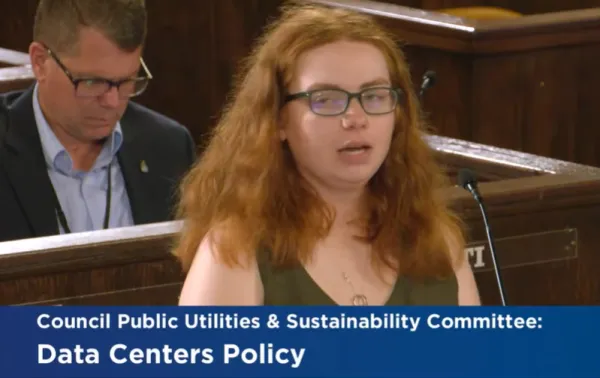
Still photo from City Council video
Twenty-four people provided testimony on draft data center policy proposed by Columbus City Council’s Public Utilities and Sustainability Committee Wednesday night. The community overwhelmingly called for a moratorium and stronger protections, with residents, engineers, and representatives of environmental groups urging City Council to stop the rapid expansion of data centers until stronger safeguards are in place.
Columbus residents and activists gathered at City Hall on July 22nd to voice their concerns about data centers in central Ohio. The Public Utilities & Sustainability Committee presented a proposed data center policy package with drafts on water, sewer, and decommissioning codes. Speaker after speaker called for a moratorium until comprehensive studies are completed and protective measures enacted, for stronger environmental protections, and greater transparency on any new data centers.
“I understand this may be controversial, but please consider that leaders of more than 50 municipalities in Ohio, including Cleveland, Dayton, and Grove City, have passed moratoriums on data centers in the past eight months, and Cincinnati has imposed restrictions on data center construction pending completion of a thorough zoning study. They have done so not because they are against data centers, necessarily, but because they recognize that this is happening too fast and they are not prepared. They need more time to study the issue and put safeguards in place to ensure they are not making hasty decisions that will have devastating long-term impacts for their communities and for their political careers,” said Becca Pollard, executive director of Buckeye Environmental Network.
Testimony also highlighted growing concern from technical experts and utility professionals who warned that current policies are failing to keep pace with the scale and speed of data center development.
“I’m an energy engineer, and I want to emphasize that there is no good way to meet the energy demand these data centers require. Even if they’re connected to the grid and buying renewable energy credits, the electricity serving them in Ohio is still primarily generated from gas and coal. If they’re using on-site generation, that increases demand for natural gas, more fracking across the state, and more pollution and health impacts for nearby communities. There’s just no good way to produce that much energy without having a dramatic impact on the state in terms of greenhouse gas emissions and pollution,” said Brian Larcey, an energy engineer and treasurer of the Capital City Chapter of the Association of Energy Engineers.
“I have a unique position where I can see in real time what projects are currently being built and what projects are in review. Right now, in New Albany alone, we're reviewing about 30 new data center and industrial sites, and more keep coming. One Google site in New Albany used 3.2 million gallons of water per day, or about 1.2 billion gallons over the past year. We're essentially playing catch-up, and it's just not working. Please listen to us. Please enact a moratorium as soon as possible,” said Dominic Mazzone, a water distribution engineer with Columbus Water and Power.
This hearing reflected a growing consensus amongst community members, advocates, and technical professionals that Columbus must strengthen its proposed data center policies to protect the environment and communities before approving new projects. Speakers raised issues around water consumption, electric grid impacts, pollution, transparency, ethics, and public oversight, while repeatedly calling on the City Council for a moratorium and to put stronger protections in place before more data centers are built.
A recording of the full hearing can be found on Columbus City Council’s YouTube: https://www.youtube.com/live/073uVZavS1Q
Spoken testimony that was submitted in writing is posted here.
Buckeye Environmental Network is calling on Columbus residents to reach out to Columbus City Council and Mayor Ginther to share your questions, concerns, and policy ideas regarding data centers, and to consider providing testimony at the next scheduled hearing on this topic on September 16, where the Committee will present updated draft policy proposals.
Buckeye Environmental Network (BEN) works to support grassroots environmental justice organizing and to protect Ohio’s native forests. Working with grassroots community groups, we provide activists the tools and support needed to mobilize their communities for effective action against the harms caused by corporate assaults. We foster public pressure on government and corporations to protect communities and Ohio’s environment. Through community action and ecological protection, we seek fundamental changes that improve our relationships with each other and the land.